Abstract
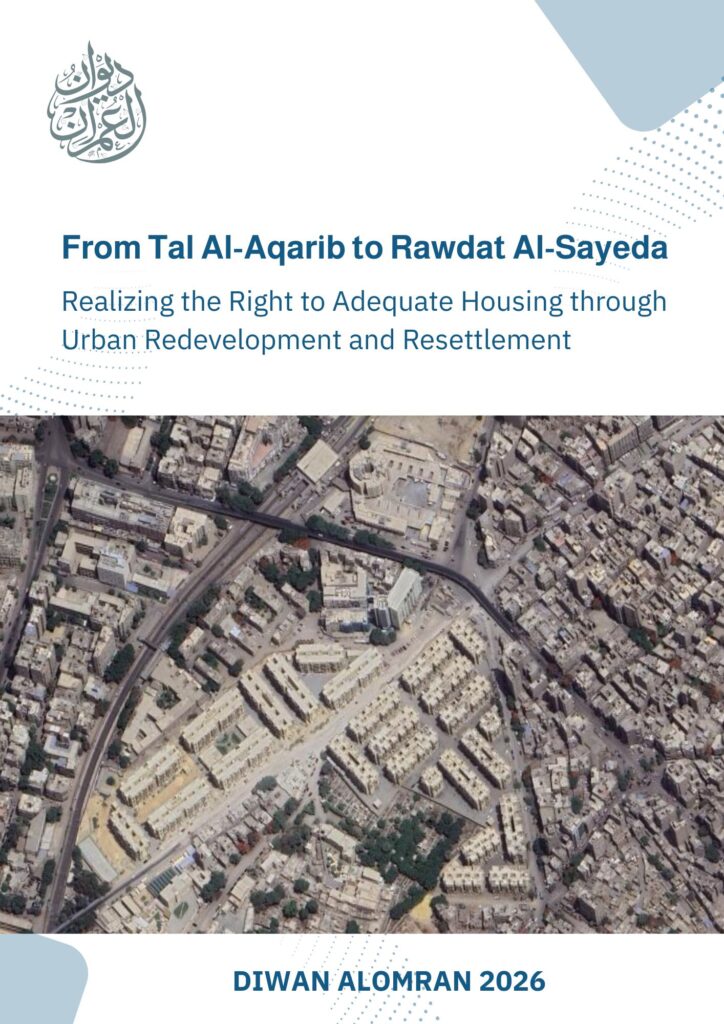
This study examines the extent to which the right to adequate housing has been realized in the “Rawdat Al-Sayeda” project. This project was developed to replace the former “Tal Al-Aqarib” area in the Al-Sayeda Zainab district in Cairo.
Physical and urban redevelopment alone do not fulfill the right to adequate housing, especially its social, economic, and cultural dimensions defined by international human rights law.
The study uses a human rights–based framework, relying on General Comment No. 4 on the Right to Adequate Housing. This comment, issued by the Committee on Economic, Social and Cultural Rights, interprets Article (1\11) of the International Covenant on Economic, Social and Cultural Rights (ICESCR). The framework outlines seven elements: security of tenure; availability of services, materials, facilities, and infrastructure; affordability; habitability; accessibility; location; and cultural adequacy.
The study uses a qualitative approach, including (15) in-depth resident interviews conducted from May to July 2022, and analyzes relevant literature and reports.
The findings reveal that the “Rawdat Al-Sayeda” project led to significant improvements in infrastructure and services. Access to water, electricity, sanitation, and gas has improved, and residents now experience greater safety and clear upgrades to the built environment.
Despite these advances, key issues remain. Security of tenure is insufficient; residents lack ownership rights and inheritance mechanisms, creating uncertainty. Many residents struggle to afford housing costs, as rent and prepaid services impose a heavy financial burden, leading to rent arrears and occasional eviction notices for low-income households.
Additionally, the study finds that community participation in the project was weak, and no social or economic impact assessments were performed before or during implementation. Cultural adequacy issues and disruption of social networks are also notable challenges hindering the full realization of adequate housing.
The “Rawdat Al-Sayeda” project redeveloped unsafe areas but did not fulfill the right to adequate housing. A full solution requires more than physical upgrades; it must address social, economic, and cultural housing needs.
The study recommends reviewing the prepaid service system, improving security, and establishing services such as childcare and social support centers. It also suggests supporting local economic activities. At the policy level, it calls for applying housing standards in urban planning, conducting impact assessments, and enhancing community participation for sustainable urban development.